

Why doth thou,
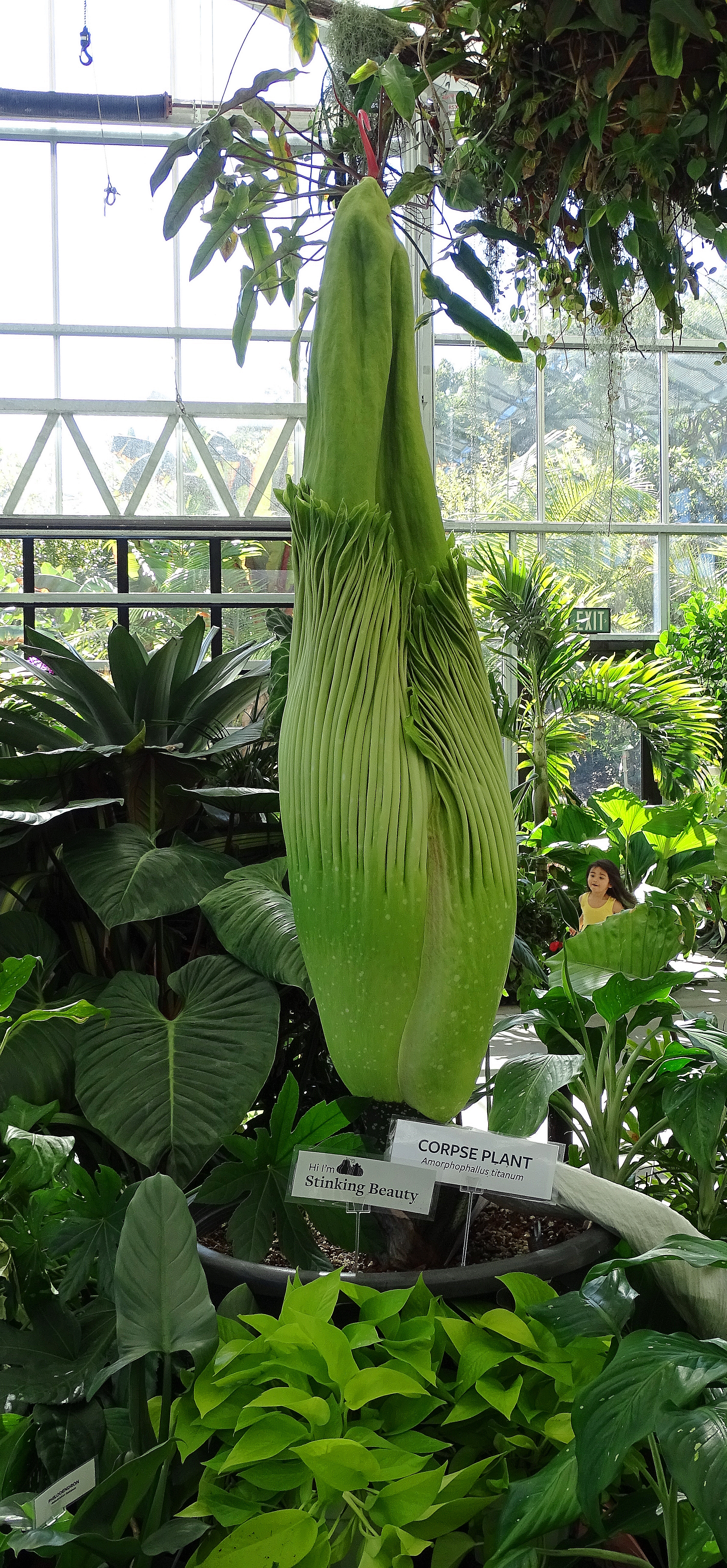
stink so much?

This is the flower bud of a corpse plant, named for the rancid corpse like smell the flower emits when it blooms. The smell attracts carrion beetles who pollinate the flower. The flower itself is the tallest in the world and can grow up to twelve feet in the wild. You can get a sense of how huge the bud is by comparing it to the exit door in the first photo, and the child in the second. It grows only on the island of Sumatra and is extremely endangered with about 1000 of the plants left in the wild. The flower bud grows six inches a day, and when it blooms, the flower only lasts for 48 hours. There are two of these flowers at The San Diego Botanic Garden. Watch the first one bloom in a time lapse video below filmed by Botanic Garden staff, appropriately enough, on Halloween:
This plant reminds me of the Saturday Sci Fi movies I used to watch as a kid! The plant takes about ten years to bloom, and will only bloom every four-ten years thereafter. It’s corm can weigh 339 pounds! As the flower begins to bloom, the temperature of parts of the flower rise by up to 10 degrees Celsius in a process called thermogenesis. The second bud at the San Diego Botanic Garden is due to bloom around Thanksgiving. The garden stays open until midnight during the bloom and 5000 people queued to see the first flower! People drive from out of state to see it.

Notice the detail of the bud petals. It looks a bit like a giant Bok choy!

This is the base of the first flower that bloomed. The female flowers are the red ones on the bottom, and the males are the brown ones above. It is the male flowers that rise in temperature during the bloom.
Cheers to you from the soon to bloom, very tall, and very stinky corpse flower~
Share this:

Discover more from Cindy Knoke
Subscribe to get the latest posts sent to your email.
Amaaaazing! So was it really smelly?? 😉
I was wearing a mask, due to covid, not the corpse! 😉 I detected an odor, but not bad. I imagine it would be quite intense inside a green house, in full bloom, on a hot Holler night! And it is very hot here now.
Wow, I have never even hear of this before. So cool! Thanks for sharing,
-Julie
You are most welcome & please you enjoyed 👽
Excellent post, Cindy. That is one stinking big plant and flower.
Almost unreal!
Yes. Very true!
Good Lord, I’ve never seen this before, yikes! I’m glad I can’t smell it, It looks like some kind of alien.👽😂
It does look like the same sort of alien that kept me awake on Saturday nights as a kid after watching Sci Fi movies! 👽👽
Wow Cindy, what an amazing plant, and the flower is so huge ! It must put off an awful stink, if it is so large.
Yes. It is said to be quite noxious at full bloom.
they had one of those over in Vancouver. It bloomed back in mid August.
https://www.cbc.ca/news/canada/british-columbia/corpse-flower-blooms-vancouver-1.6146397#:~:text=18-,A%20towering%20corpse%20flower%20has%20released%20its%20pungent%20odour%20in,releasing%20its%20trademark%20fetid%20stench.
There are estimated to be around five human cultivated blooms of this plant each year in the world. A rather rare event დ
The Botanical Garden in Bonn has one, but I never went there to smell it. 😉
It does. I read about it. I hear the full bloom smell is irritating to eyes, nose and throat.
A sci-fi bok choy — fascinating post!
What a great title!! 😉
Thank you for including the time-lapse video. What an amazing plant!
It is incredible isn’t it დ
I have heard of this flower, but I did not know what it looked like. It’s actually kind of sexy looking! Isn’t nature amazing?!
Flowers are beautiful, and sexy! 😉
Cheers to nature!
She has created a masterpiece!
Cindy, thank you for these educational pics! ❦
Mother Nature rocks, (and so do you Resa!) დ
დ დ
Though you said the flower smells, it is so beautiful.
I am very happy you think it is beautiful დ
🙂
“Stinking beauty” made me laugh. Awesome, thank you for sharing.
Just like Sleeping Beauty, albeit a bit different 😉
Oh my Cindy I have herd of these but have never seen one ❗️ do they stink worse then cats❓ ~Willy
Thank you Cindy, this is a strangely emotive very important post. Thanks for this. At first i thought it was your garden.
Narayan x
Mother Nature is emotive isn’t she and we are just one of her amazing creations. Thank you for your kind comment Narayan დ
That is a very large and interesting plant! I’ve never seen one of those. They look like they could swallow a human.
Yes, they definitely do look like could and would!! There was some scary movie about plants that did this….. 😉
Amazing! I am tempted to drive cross country just to see it bloom. Thankyou for sharing this very strange apparition.
You are very welcome Dor. Some man from Texas did just that! Drove overnight to see it.
That is quite the interesting lesson, Cindy. Thanks for this post.
You are very welcome. Test on Tuesday! 😉
Yikes!
I saw one at the Chicago Botanic Garden. They are amazing. Your photographs were excellent and the video was great. Thank you.
I heard about the Chicago bloom. There are about five cultivated blooms per year worldwide, so you are lucky to see it დ
I have seen these on tv but not in a greenhouse or garden. Amazing what nature contrives to ensure survival! Thanks for including the video.
You are most welcome Lynette & I am happy you enjoyed დ
Great post about our new plant overlords, Cindy. I feel for those living in Sumatra but it’s wonderful that you could see and photograph it for us. Best, Babsje
I love the “plant overlords” idea. It would be nice if we were to respect them as such wouldn’t it. დ
Yes I agree. The prevailing human-centricity bodes ill for our lovely planet Earth. 🌎
Yes. Unfortunately too many of us excel at destruction.
Aren’t they fabulous? One of these flowered in Dunedin Botanic Garden, New Zealand in 2018. Just before we moved away from the city. For anyone interested.. I blogged photos and this link will bring up the posts: https://exploringcolour.wordpress.com/?s=titan+arum
So your post was where I had seen this plant before! Thanks for the memory prompt. Your photos are wonderful! Only around five cultivated blooms occur each year, so your experience was remarkable დ
Awesome post, Cindy. Weird and wonderful. The inside of the plant looks fleshy, in the IG video. Thanks for sharing!
It does look fleshy……. and smells that way too!! 😉
I am sure that leaves a lasting impression. 😆
Laughing……..
Amazing! I think it looks like a bok choi too.
Laughing. Great minds think alike დ
🙂
Wow. Incredible.
I can’t happening on this unprepared while on a nature hike!! 😉
Such interesting details! I love botanical gardens. Gothenburg have a fantastic botanical garden that I am planning on visiting this spring. Thank you for sharing this interesting plant. Happy Friday!
I have been to gorgeous Gothenburg and the botanical garden. Enjoy! It is wonderful დ
Wonderful!! I lived in Gothenburg for two years in my early 20’s.
დდდ
Wonderful in a bizarre way. It reminds of the giant pods in the original “Invasion of the Body Snatchers”.
Oh yes!! I wonder if that was the imagery in the back of my head. There is some sci fi movie this plant reminded me of but I can’t quite place it…… დ
Incredible. Thanks for sharing.
You are most welcome & thanks for stopping by დ
Spectacular. I hope to see one some day. I didn’t realize they were endangered.
They are spectacular. I know The Huntington Gardens have them დ
Amazing work of nature! 😀
Agreed! დ
Absolutely beautiful 🌷😍
So happy you think so & thank you დ
🌹😊😍🌷
Wow, that really is a big one! (as they say). Thanks for sharing that timelapse – amazing to see
✨🙏🕉🌱🌿🌳🌻💚🕊☯🐉✨
Happy you enjoyed Graham. I thought it was fascinating too დ
Extraordinary. I hope they’re being protected and propagated..
They are but they are still very rare დ
Thanks a lot for sharing the lovely video and for enabling me to watch it properly.I am sure I won’t be able to see it in reality.Take care 🙏😊🌹
I am very happy you enjoyed and you make me glad I posted. Thank you დ
My pleasure.🙏😊🌹
დდ
Really amazing.
I agree & thank you! დ
Wow!!! You are so lucky to have seen this … and smelled it too. Great captures Cindy 😎
Thanks much Val. It is quite amazing დ
That’s spectacular, dear Cindy. We didn’t know that such a plant exists.
Thanks for sharing, especially the video.
Wishing you a wonderful weekend
The Fab Four of Cley
🙂 🙂 🙂 🙂
You fourare both most welcome. I love learning new things too and am so grateful Mother Earth keeps on surprising me დ
Amazing – so is the plant
You Brits were the first to propagate it outside of Sumatra, at The Kew Gardens. So hats off to you დ
🙂
Will they pollinate it in the absence of carrion beetles?
Here is what ‘Undark” journal says about this. “But fostering genetic diversity in the botanic gardens can be difficult, especially with finicky and rare plants. Like many plants, corpse flowers can reproduce in different ways. Sometimes, they reproduce asexually: a tuber-like bulge at the base of their stem, called a corm, grows large and eventually splits, producing multiple genetically identical plants. While this has effectively grown the raw number of corpse flowers in botanic gardens, it has done little for the population’s genetic diversity.
Corpse flowers can also reproduce sexually, which requires pollination by insects — or, in botanic gardens, by humans wielding paint brushes. There’s no set schedule for a corpse flower to bloom; each plant takes a variable number of years and blooms unpredictably based on conditions such as heat, light, humidity, and other factors.
To help breed on this unpredictable schedule, the Chicago Botanic Garden is creating a store of corpse flower pollen, which can be sent across the country when another specimen that isn’t closely related blooms. These targeted cross-pollination efforts could lead to more genetically robust offspring. While TREES has yet to lead to a crossing of corpse flowers, the Chicago Botanic Garden has used the methodology to strategically cross another plant called Brighamia insignis, also known as a cabbage-on-a-stick plant, which is critically endangered.”
Thanks. I had heard of the corpse plant before but I am really interested in what you have said about the botanic gardens. We visit them when we can, but I never thought of them much beyond being a site where plants were shown off. The behind the scenes science is really interesting.
So happy you are interested & thank you for letting me know.
Beautiful!!! My local conservatory had to open its ceiling to allow a 80 year old agave plant (25 feet tall) to bloom. It died after blooming but its “pups” continue its legacy. It was quite a sight to see!
It is amazing to see. We had one bloom at The Holler about two years ago. It attracted hordes of hummingbirds and butterflies. We have lots more, but they bloom only once as you know დ
Oh wow … Maybe not something to smell, but a sight to see. Your photographs give this corpse new life. 😉
Now this comment made me smile Frank. A plant necromancer დ
The size of that bud is incredible!
It is isn’t it. Apparently it takes the plant years to build up enough energy to make the bloom and it grows 6 inches a day! დ
Nature is amazing. That is one cool plant!
It is isn’t it! Thank you Alethea & cheers to you დ
Oh, yes, this plant is very, very stinky! I saw – and smelled – one some years ago at the Botanical Garden in Munich. 😉
Have a fine time, and stay safe, dear Cindy!
You have the plant in Bonn and another in Munich. I love hearing from people who have seen it bloom in cities all around our small world. It only blooms about five times per year worldwide outside of Sumatra დ
I’ve heard of the corpse plant and seen photos of it–but none like these!
Thank you Liz. You make me happy I posted დ
You’re welcome, Cindy. 🙂
The plant is huge. Hopefully it won’t eat children. 😀 Very interesting post.
Greetings Alexander
Laughing…… I took my three year old twin grandsons to see it. The plant feigned indifference! 😉
Cool 🤣
We’ve got one of these in Edinburgh’s botanic gardens. Truly fascinating (and stinky!).
Wonderful! I am hearing from people all over our small planet who live near cities who have the plant. The Kew Gardens were the first to propagate it outside of Sumatra დ
Wow! Such an interesting flower! Great info! Stinking beauty is about right 🙂
So true & funny too.
Wow! Such an interesting flower! Great info! Stinking beauty is about right 🙂
I liked that label too!! Stinking Beauty, sort of like Sleeping Beauties plant cousin!!! 😉 😉