
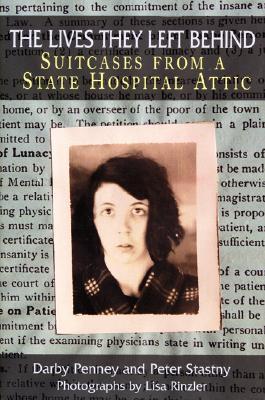
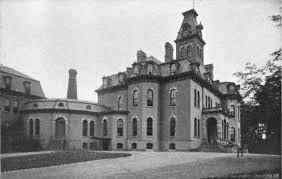
Willard State Hospital
by, Darby Penny, Peter Stastny, Lisa Rinzler, Robert Whitaker.
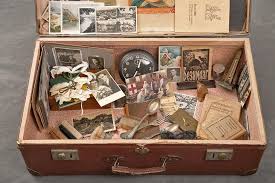
When Willard State Hospital closed in 1995, after 125 years of continuous operation, 427 patient suitcases, filled with patient’s personal belonging, were discovered, abandoned, in an attic.

This interesting book attempts to bring to light the personal stories of ten of these patients whose suitcases were intensely studied. The authors chose these specific suitcases because there were a lot of personal notes and materials in each of these ten suitcases, that provided the authors with enough data, combined with patient records and charts, to try to reconstruct these ten people’s lives.
This is a fascinating book about these people’s lives and about the hospital itself. The authors are incredibly patient detectives, who tease out a great deal of facts and details from these suitcases, chart notes, and interviews with hospital staff members, many retired. They locate living relatives of the deceased patients and also interview them whenever possible. The reader feels as if one is reading a riveting detective story x 10, but it is non-fiction, which makes it all the more remarkable.
“The Willard Asylum for the Insane,” opened in Ovid, New York in 1896. It closed in 1995. 54,000 people were committed to Willard during its 126 years of operation. Most patients stayed at Willard for an average of 30 years. One woman for example, arrived 1899, and died 77 years later in the hospital at the age of 100. Half the patients who entered the facility died there.
Many of the people who were admitted to Willard would not meet the criteria for involuntary hospitalization today. Many were immigrants, who had experienced a series of major stresses in their lives such as the death of a spouse, loss of a job, poverty, homelessness, one woman was regularly beaten by her spouse. There was a nun who left her order and had nowhere else to go. And of course, many patients did have major psychiatric disorders.
Today most of these people, if lucky enough to be able to GET treatment, would receive short-term treatment on an outpatient basis, living in board and care homes. Or they might live on their own with case management, or as quite often occurs, they would live on the streets with no medication or treatment at all, either because services are unavailable, or patients are non-compliant. Many mentally ill people today, who could be helped by a short stay in a psychiatric hospital, therapy, and medication, are unable to receive these services and end up living on our streets
What makes this book so interesting, is not these grim statistics, but the detective work the writers embark on to tell the stories of these people’s incredible lives. Who were these people who were left behind and forgotten? Where did they come from? Why were they left here for so long? What was their story?
The bulk of the book examines these people lives and answers these questions, and it is a riveting read. You will find yourself drawn into to these people’s lives and experiences, taken back to the times they lived, and you will see their experience through their eyes. This is a major accomplishment on the part of these four authors. The authors, one of whom is a psychiatrist, and another a journalist and advocate for the mentally ill, are all exceedingly patient, master-detectives.
The suitcase project eventually became an exhibit, that traveled around the country and I have included the following link for you to see. It gives an idea of how interesting and compelling this book is.
http://www.suitcaseexhibit.org/indexhasflash.html
Highly recommend.
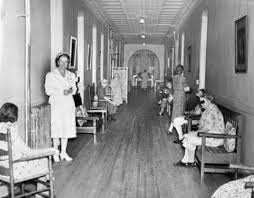
Willard Hospital
(Photo Source: The Suitcase Project: The Lives They Left Behind).
